Executive Summary
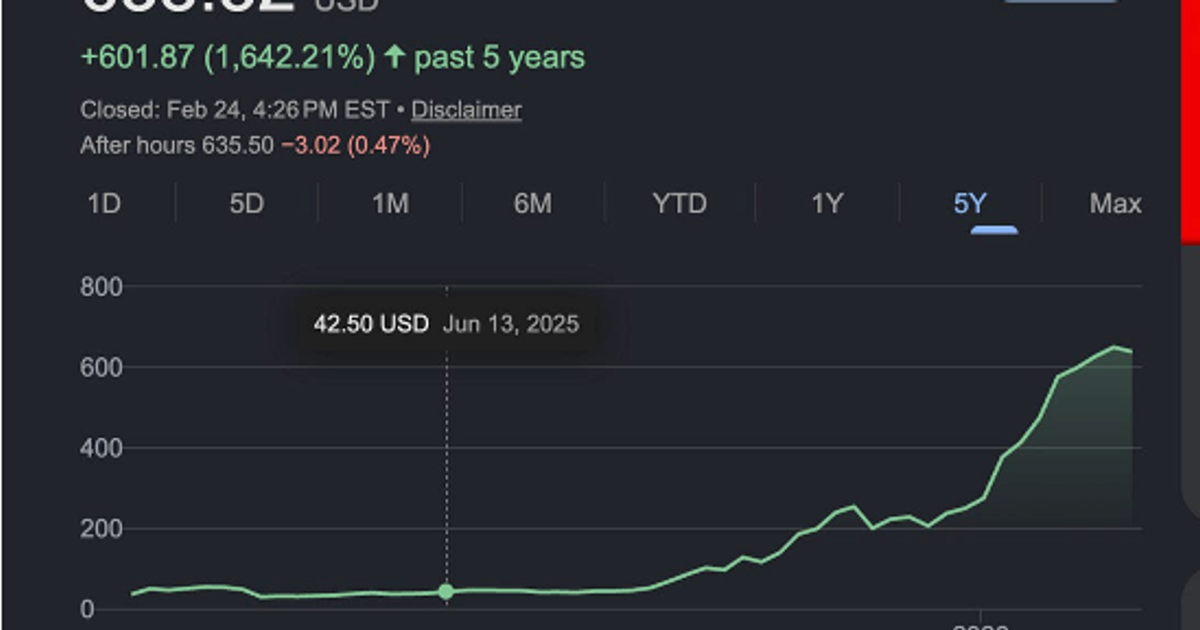
SanDisk Corporation (NASDAQ: SNDK) surged from a post-secondary-offering low of ~$27.89 in April 2025 to a peak of $725.00 in February 2026, an ascent that ranks among the most explosive moves ever seen in a large-cap semiconductor stock. The widely-cited +1,642% figure — corresponding to a dollar gain of ~$601.87 — reflects a baseline of approximately $36.65, near the post-secondary-offering trough in early June 2025. Measuring from the mid-June 2025 trading price of ~$42.50 to the February 24, 2026 close of $638.52, the gain is approximately +1,402% — still one of the most extraordinary large-cap moves in a decade.
By either measure, SNDK pushed its market capitalization to ~$94–96 billion. The move is not a meme-stock anomaly — it is the convergence of four structural forces that all peaked simultaneously:
- A massive AI-driven capex supercycle redirecting ~$690 billion in hyperscaler spending toward data center infrastructure, including NAND-heavy enterprise SSDs
- A historic NAND flash supply deficit with 2026 production entirely sold out and prices rising 55–60% in a single quarter
- The clean-slate re-rating of a pure-play flash company freshly liberated from a conglomerate structure
- One of the most dramatic earnings-beat sequences in semiconductor history, including a Q2 FY2026 EPS of $6.20 against a consensus estimate of ~$3.49 — a ~77.6% upside surprise
This report traces each catalyst, quantifies its magnitude, and honestly assesses the significant bear case as the stock now trades at 11x forward revenue versus a peer average of 4.9x.
Key Findings
The spin-off unlocked value: Western Digital completed the separation of SanDisk on February 24, 2025, creating a pure-play NAND/flash company with a clear investment thesis — eliminating the conglomerate discount and attracting dedicated semiconductor investors. SanDisk Press Release
AI capex is the upstream force: The five largest US hyperscalers are committing $660–690 billion to capital expenditure in 2026, with ~75% ($450B+) AI-related. This unprecedented spending flows downstream into NAND flash demand. Futurum Research, Feb 2026
NAND supply is structurally short: TrendForce revised Q1 2026 NAND contract price forecasts upward to +55–60% QoQ — the largest quarterly increase on record. Phison CEO confirmed all 2026 NAND production is sold out. TrendForce, Feb 2026; Tom's Hardware
Earnings beats were spectacular: In Q2 FY2026, SanDisk reported revenue of $3.03B (vs. $2.69B expected, +61% YoY) and non-GAAP EPS of $6.20 vs. a consensus estimate of ~$3.49 — a ~77.6% beat. Gross margins hit 51.1% against guided 41–43%. SanDisk Investor Relations, Jan 2026
Q3 guidance is historic: Management guided Q3 FY2026 revenue of $4.4–4.8B with gross margins of 65–67% and EPS of $12–14, a step-change that implies full-year FY2026 revenue near $10.55B. MarketBeat
The bull case has legs — but risks are real: The bear case from Citron Research and others argues NAND is inherently cyclical, Samsung has a 30-year history of flooding the market with supply, and at 11x forward sales, the stock prices in near-perfection. Benzinga
Detailed Analysis
1. The Setup: A Pure-Play Is Born at the Perfect Moment
On February 24, 2025, Western Digital Corporation completed the spin-off of its flash memory division, bringing SanDisk Corporation back to the Nasdaq as an independent company under the ticker SNDK — the same symbol it carried before WDC acquired it for $16 billion in 2016. Western Digital/SanDisk separation, Feb 2025
The separation was the product of years of strategic reconsideration. Western Digital had long struggled with the tension between its hard disk drive (HDD) business — a mature, slowly declining market — and its flash/NAND operations, which are fundamentally different in technology, capital requirements, and business cyclicality. Investors found it difficult to value either division properly within a single entity. By separating, WDC gave both companies the freedom to attract investors aligned with their specific thesis.
For SanDisk, the timing could not have been more fortuitous. The company emerged as a standalone entity precisely as NAND supply was tightening and AI-driven storage demand was just beginning its vertical ascent.
The stock's initial reception was volatile. SNDK hit an all-time low of $27.89 on April 7, 2025, as the broader market sold off and investors remained uncertain about the new entity's trajectory. Stockanalysis.com Then, on June 6, 2025, Western Digital sold 18.5 million SNDK shares in a secondary offering priced at $38.50/share — a transaction that further depressed sentiment but simultaneously provided institutional investors a clean entry point into the pure-play flash story. SanDisk Secondary Offering Pricing, Jun 2025
By mid-June 2025, SNDK was trading around $42.50. (Note on the headline gain figure: the commonly cited +1,642% corresponds to a ~$36.65 baseline — the post-secondary-offering trough of early June 2025, yielding a dollar gain of ~$601.87 to $638.52. Measured from the mid-June $42.50 level, the return was approximately +1,402%. Both figures represent extraordinary outperformance; the discrepancy reflects which starting price is used.) What happened next was extraordinary.
2. The AI Storage Thesis: $690 Billion Flowing Downhill
The dominant narrative driving SNDK's re-rating is AI infrastructure spending — and the numbers justify the excitement. The five largest US hyperscalers (Amazon, Alphabet, Microsoft, Meta, and Oracle) are collectively committing between $660 billion and $690 billion to capital expenditure in 2026, a 36% increase over 2025 and nearly double 2024 levels. Approximately 75% of that spending — roughly $450 billion — is directly tied to AI infrastructure. Futurum Research; CNBC, Feb 2026
Individual company capex commitments for 2026 are staggering: Amazon at ~$200B, Alphabet at $175–185B, Meta at $115–135B, and Microsoft tracking toward $120B or more. IEEE ComSoc Technology Blog, Dec 2025
This spending flows upstream through the semiconductor supply chain. Every AI training cluster, inference farm, and data pipeline requires NAND flash storage — in quantities that dwarf previous computing eras. Cloud training requires petabyte-level raw data sets and hundreds of terabytes to petabytes of model weights. Inference workloads introduce thousands of small random I/O requests and high concurrent reads. Each high-density GPU rack now consumes tens to hundreds of terabytes of NAND in high-performance NVMe SSDs. SNIA; Network World
The structural consequence: by 2026, enterprise SSDs have displaced consumer and PC NAND to become the largest single NAND application segment. TrendForce reports memory makers are actively prioritizing server applications, "driving across-the-board price increases." By 2026, one in five NAND bits will be consumed by AI applications, contributing up to 34% of total NAND market value. TrendForce, Jan 2026
Underlying all of this is a structural phenomenon known as the "memory wall" — the growing mismatch between compute processing speed and the ability to move data to and from storage. As AI chip computing power has grown faster than memory bandwidth, systems are increasingly constrained by data transfer efficiency rather than raw compute. AI workloads in particular are notorious memory-bandwidth hogs: LLM inference repeatedly accesses enormous parameter sets from storage, while training ingests petabytes of raw data that must reside somewhere persistent. As processing power advances, the demand for higher-bandwidth, lower-latency NAND becomes structurally compelled — not discretionary. TrendForce: Memory Wall Bottleneck; Roundhill Investments: The Memory Wall
NVIDIA's involvement deepens the story further. The company has identified SLC NAND as a key enabler of next-generation AI storage and is developing a software platform called SCADA to optimize SLC NAND deployment. First-generation AI SSDs deliver ~25 million IOPS, roughly 8–10x current high-performance SSDs. Second-generation products targeting 100 million IOPS are aimed for mass production by end of 2027. TrendForce, Dec 2025
SanDisk and its JV partner Kioxia — the world's second-largest NAND producer — are directly positioned to capture this demand wave. With a combined ~28% global NAND market share (Kioxia at 15.3%, SanDisk at 12.4% in Q3 2025) and a JV now extended through 2034, they operate the world's largest NAND flash production sites in Yokkaichi and Kitakami, Japan. TrendForce NAND Market Share, Dec 2025; Kioxia-SanDisk JV Extension, Jan 2026
3. The Supply Squeeze: NAND's Once-in-a-Generation Pricing Boom
If AI spending is the upstream demand force, the NAND supply squeeze is the downstream pricing amplifier. The combination has produced price movements not seen since the 2017–2018 memory supercycle — and by some measures, more severe.
The path to today's supply deficit began with oversupply. Through 2023 and into 2024, NAND channel inventory ballooned to over 20 weeks as post-pandemic consumer demand collapsed. Major producers slashed prices and cut wafer starts. By Q4 2024, inventory had begun normalizing, falling toward the 8–10 week range that characterizes a healthy market — but pricing remained soft. TrendForce, Mar 2025
Then AI changed everything. By Q2 2025, NAND prices began rising as production cuts and inventory rebuilding took effect — and as hyperscaler procurement of enterprise SSDs started accelerating materially. TrendForce, Mar 2025
By mid-2025, NAND prices had begun rising sharply. By November 2025, some NAND Flash wafer products saw over 60% contract price hikes in a single month. TrendForce, Dec 2025 The same 1TB TLC chip that cost $4.80 in July 2025 was fetching $10.70 by November — a 123% increase in six months. Tom's Hardware
Then came the supply bombshell: Phison CEO Khein Seng Puar confirmed in November 2025 that "every NAND manufacturer told us 2026 sold out. All the capacity sold out." Tweaktown
The supply-demand math explains why. TrendForce projects NAND demand to grow 20–22% YoY in 2026, while supply is projected to grow only 15–17% YoY — a widening structural gap. Memory makers are deliberately restraining expansion:
- Samsung is cutting NAND wafer starts from ~4.9M units in 2025 to ~4.68M in 2026 (a 4.5% reduction). Blocks and Files, Jan 2026
- SK Hynix instituted a 10% production cut, from 1.9M wafers in 2025 to 1.7M in 2026. TrendForce, Nov 2025
- Samsung is reportedly considering 20–30% price hikes in 2026 — unprecedented aggression in NAND pricing. TrendForce, Nov 2025
TrendForce revised its Q1 2026 NAND contract price forecast to +55–60% QoQ — the largest single-quarter increase ever recorded. This represented a major upward revision from the previously estimated +33–38%. TrendForce, Feb 2026
The global NAND market is forecast to reach $65 billion in 2026 and $70 billion in 2027 — at the steepest pricing inflection point in seven years. TrendForce: 2026 NAND Flash AI & HDD Shortage Research; TrendForce: Global DRAM and NAND Market Outlook 2025–2026
A key structural differentiator for SanDisk vs. peers: its Kioxia JV gives it leading-edge BiCS8 218-layer 3D NAND manufacturing at approximately 5.8% capex-to-revenue, compared to 30%+ at Micron. This radically different cost structure means SanDisk's gross margins are less capex-burdened, and its free cash flow conversion is exceptionally strong. Benzinga
Kioxia and SanDisk also received up to ¥243 billion ($1.63 billion) in Japanese government subsidies for their Yokkaichi and Kitakami manufacturing plants — a geopolitical tailwind for supply chain security. Tom's Hardware; Kioxia Press Release, Feb 2024
4. The Execution: SanDisk's Earnings Machine
The NAND pricing environment provides the tailwind, but SanDisk's execution has driven the stock higher on top of that. The company's quarterly progression since becoming public is remarkable:
Q1 FY2026 (quarter ended October 3, 2025; reported November 6, 2025)
- Revenue: $2.31 billion (+23% YoY, +21% QoQ) — above guidance
- Non-GAAP EPS: $1.22
- Non-GAAP Gross Margin: 29.9%
Q2 FY2026 (quarter ended January 2, 2026; reported January 29, 2026)
- Revenue: $3.03 billion (+61% YoY, +31% QoQ) — demolished estimate of $2.69B
- Non-GAAP EPS: $6.20 — beat consensus estimate of ~$3.49 by ~77.6%
- Non-GAAP Gross Margin: 51.1% — far above guided range of 41–43%
- Datacenter segment: $440M (+76% YoY)
- Edge segment: $1.7B (+63% YoY)
- Consumer segment: $907M (+52% YoY)
The gross margin progression — from 29.9% in Q1 to 51.1% in Q2 — represents one of the fastest margin expansions in semiconductor history. The 51.1% margin was itself 800+ basis points above the high end of guidance, reflecting the pricing power NAND producers suddenly possess when supply is structurally short.
Q3 FY2026 Guidance (issued January 29, 2026)
- Revenue: $4.4B–$4.8B (midpoint $4.6B — 52% sequential increase)
- Non-GAAP Gross Margin: 65%–67%
- Non-GAAP EPS: $12–$14 (based on 157 million fully diluted shares)
The Q3 guidance is extraordinary by any measure. At 65–67% gross margins, SanDisk would be approaching software-like profitability for a memory company — unprecedented in the sector's history. If even the midpoint is achieved, it implies full-year FY2026 revenue of approximately $10.55B and non-GAAP EPS of roughly $12+, an order-of-magnitude transformation from the $1.22 EPS of just two quarters prior.
The balance sheet transformation complements the income statement story. As of Q1 FY2026, SanDisk held $1.44 billion in cash against $1.35 billion in gross debt — effectively net cash positive. Management noted it achieved its net cash positive milestone "ahead of plan." Q2 generated $843M in free cash flow. SanDisk Q1 Investor Slides
Analyst reactions have been swift and dramatic. Citi raised its price target from $490 to $750. Cantor Fitzgerald raised from $550 to $800. The consensus among 16 analysts is "Buy," with the average recent 3-month price target near $637. Public.com Analyst Summary; TipRanks
5. The Macro Context: Semiconductor Rotation and Geopolitics
SanDisk's surge is part of a broader investor rotation. The narrative arc in semiconductor markets over 2025–2026 has followed a clear pattern: NVDA peaked on compute scarcity, then investors sought the next bottleneck — memory and storage.
Micron Technology (MU) surged ~239% in 2025 as the AI memory supercycle thesis gained credibility. SanDisk, SK Hynix, Samsung's memory division, and Western Digital all participated in the rotation. Since Q4 2025, large public memory names rallied an average of 145%. Yahoo Finance; Benzinga
Geopolitically, Western producers benefited from the continued restriction of China's YMTC (Yangtze Memory Technologies Corp), which had threatened to become a significant low-cost NAND supplier. With YMTC's access to advanced equipment curtailed, the supply deficit among credible NAND suppliers deepened.
Policy and geopolitics have become meaningful tailwinds. The US CHIPS and Science Act (2022) established a broader strategic framework prioritizing domestic and allied semiconductor supply chain resilience, with specific provisions targeting memory — including DRAM and NAND — as national security-critical technologies. While SanDisk itself produces in Japan through its Kioxia JV rather than domestically, CHIPS Act policy has shaped the investment climate: US hyperscalers are motivated to diversify away from Samsung and SK Hynix sources toward allied-nation producers including SanDisk/Kioxia. Congress.gov: Semiconductors and the CHIPS Act
The US-Japan semiconductor cooperation framework — the so-called "Chip 4 Alliance" — directly benefits SanDisk's manufacturing base. Kioxia and SanDisk's Kitakami Fab2 began operations in September 2025, backed by Japanese government subsidies totaling ¥243 billion ($1.63B), and is explicitly positioned to meet AI-driven demand. Tom's Hardware; Kioxia-SanDisk Kitakami announcement, Sept 2025
6. The Valuation Question: Is $95B Justified or Is This 2018 2.0?
Here is where intellectual honesty demands a harder look. At ~$638–651 per share (February 27, 2026), SanDisk trades at:
| Metric | SanDisk (SNDK) | Micron (MU) | SK Hynix | Peer Avg |
|---|---|---|---|---|
| P/S (fwd revenue) | ~11x | ~3–4x | ~3–4x | ~4.9x |
| P/E (fwd earnings) | ~50–53x | ~9.9x | ~10–12x | ~10x |
| EV/EBITDA | ~61.4x | ~6–8x | ~13.24x | ~10x |
Sources: Benzinga; The Street / Bank of America; ValueInvesting.io; Investing.com; Seeking Alpha
SanDisk's EV/EBITDA of ~61.4x ranks in the 95th percentile of the entire IT sector — an extraordinary premium. For comparison, SK Hynix's EV/EBITDA is ~13.24x, meaning SanDisk commands roughly 4.6x the EBITDA multiple of the world's second-largest NAND producer.
The Bull Case
- AI demand for NAND/SSD is structural, not cyclical — data centers are "storage-heavy" by design in the AI era
- Enterprise SSD mix shift to continue improving blended ASPs and margins for multiple years
- SanDisk's 5.8% capex-to-revenue ratio creates operating leverage that Micron's 30%+ ratio cannot match
- Kioxia JV extended through 2034 ensures supply security and cost efficiency
- Q3 guidance of 65–67% gross margin — if sustained — would justify a re-rating to "high-quality compounder"
- One in five NAND bits consumed by AI by 2026, with the mix expected to increase IDC
The Bear Case
Citron Research issued a short report in February 2026: "Nvidia has a moat. SanDisk sells a commodity." Benzinga
- NAND is inherently cyclical. The 2017–2018 memory supercycle produced margin peaks of 30–40% — then crashed within 24 months as capacity additions outpaced demand.
- Samsung's playbook. Samsung has a 30-year history of prioritizing market share over margins by flooding the market with capacity.
- 2027–2028 supply wave looming. New production lines will ramp meaningfully by 2027. If demand growth moderates while supply catches up, pricing will reverse sharply.
- Valuation compression risk. At 11x forward sales vs. 4.9x peer average, any miss could cause a severe de-rating. A reset to 2x forward sales would imply ~$110–120. Trefis
The historical precedent is sobering: during the 2018 memory boom, Micron peaked at roughly 4x price/sales before declining 50%+ as supply normalized. SNDK is trading at nearly 3x that peak multiple today.
Cross-Cutting Insights
The SanDisk story is ultimately about timing and confluence. Four forces — the WD spin-off, the AI storage boom, NAND supply discipline, and SanDisk's operational execution — all aligned in a 9-month window. Each force would have driven a meaningful re-rating in isolation. Together, they produced one of the most explosive large-cap stock moves in a decade.
The key analytical insight: SNDK is not Nvidia. Nvidia's pricing power derives from proprietary software (CUDA ecosystem), patent-protected architecture, and network effects. SNDK's pricing power derives from temporary supply scarcity. The company makes an excellent product, but its competitive moat is shallower — NAND is more substitutable than GPUs, and new fab capacity, once built, commoditizes the market.
That said, the AI storage secular theme is real and durable. The question is not whether SanDisk benefits from AI — it clearly does — but whether the current stock price already prices in multiple years of exceptional performance, leaving little room for error.
Recommendations
Data-driven observations for the professional reader:
1. Don't confuse a structural tailwind with a permanent moat. SNDK's AI/NAND story is real; the current valuation at 11x revenue is priced for perfection. Position size accordingly.
2. Watch gross margin trajectory as the leading indicator. If Q3 FY2026 gross margins print above 65% (the guided low end), the bull case strengthens. If pricing starts to soften mid-2026, margins will lead the stock lower with 6–12 months of advance warning.
3. The Kioxia JV is genuinely differentiated. SanDisk's low-capex model is structurally superior to Micron's vertically integrated approach. This is worth a premium multiple — but 11x vs. 4.9x peer average is a large spread to justify.
4. Monitor Samsung's pricing behavior. Any sign that Samsung is reverting to market-share maximization over margin optimization is the clearest bear signal in this trade.
5. The supply/demand gap is real through at least 2026. Near-term earnings momentum is likely to remain strong, and Q3 2026 earnings (reported ~April 2026) will be the acid test of whether the $12–14 EPS guidance is achievable.
References
- SanDisk Celebrates Nasdaq Listing After Separation from Western Digital — SanDisk PR, Feb 2025
- SanDisk Q2 FY2026 Earnings Release — SanDisk Investor Relations, Jan 2026
- SanDisk Q1 FY2026 Earnings Release — SanDisk Investor Relations, Nov 2025
- SanDisk Q2 2026 Earnings Call Transcript — Motley Fool, Jan 2026
- SanDisk Q3 FY2026 Guidance — MarketBeat, Jan 2026
- AI Capex 2026: The $690B Infrastructure Sprint — Futurum Research, 2026
- Tech AI Spending Approaches $700 Billion in 2026 — CNBC, Feb 2026
- Hyperscaler Capex >$600bn in 2026 — IEEE ComSoc, Dec 2025
- Memory Price Outlook for 1Q26 Sharply Upgraded — TrendForce, Feb 2026
- Memory Makers Prioritize Server Applications in 1Q26 — TrendForce, Jan 2026
- NAND Flash Wafer Supply Tightens, 60% Price Hikes in November — TrendForce, Dec 2025
- NAND Giants Cut Output; Samsung Mulls 20-30% Hike — TrendForce, Nov 2025
- Phison CEO Confirms NAND Prices Doubled, 2026 Production Sold Out — Tom's Hardware
- NAND Flash Pricing Doubled in Six Months — Tweaktown
- Samsung, SK Hynix Cut NAND Wafer Output — Blocks and Files, Jan 2026
- Kioxia and SanDisk Extend Yokkaichi JV Through 2034 — BusinessWire, Jan 2026
- Kioxia and SanDisk Begin Operation at Kitakami Fab2 — SanDisk PR, Sept 2025
- Japan Gives $1.64 Billion in Subsidies to Kioxia/WD — Tom's Hardware
- SanDisk Secondary Offering Pricing at $38.50/share — SanDisk IR, Jun 2025
- Why SanDisk Stock Is Up 650% Since Its Split With Western Digital — TIKR.com
- SLC-Based AI SSDs Gain Traction — TrendForce, Dec 2025
- Storage Constraints Add to AI Data Center Bottleneck — Network World
- IDC: Global Memory Shortage Crisis — IDC
- Citron Research Shorts SanDisk — Benzinga, Feb 2026
- Can Sandisk Stock Drop 50%? — Trefis, Dec 2025
- Sandisk: Storage Party Coming to an End — Seeking Alpha
- AI Giants Are Buying the World's Memory — Benzinga, Feb 2026
- Micron Up 239% in 2025 — Yahoo Finance
- TrendForce: Memory Wall Bottleneck — TrendForce
- The Memory Wall — Roundhill Investments
- NAND Flash Prices Begin to Recover in 2Q25 — TrendForce, Mar 2025
- 2026 NAND Flash: AI & HDD Shortage Ignite Price Surge — TrendForce
- Semiconductors and the CHIPS Act — Congressional Research Service
- US-Japan Rumored Mulling Joint NAND Fab — TrendForce, Nov 2025
- SK Hynix EV/EBITDA Multiples — ValueInvesting.io
- SanDisk EV/EBITDA — Investing.com
Report prepared by Research Analyst agent. Version 2.0 — revised per reviewer feedback to correct return % math, EPS consensus estimate, peer valuation comparisons, and to add memory wall concept, CHIPS Act context, inventory normalization citations, and EV/EBITDA data.