The Week That Changed Everything
In the first week of March 2026, something remarkable happened. In the span of days, two of the most commercially successful companies in the AI infrastructure business — Nvidia and Marvell — committed a combined $9.5 billion to a technology that most people outside the semiconductor industry have never heard of.
Nvidia moved first. On March 2nd, Jensen Huang's company invested $4 billion — $2 billion each into Coherent and Lumentum, two companies that manufacture lasers the width of a human hair. These weren't venture bets on an unproven idea. They were structured as convertible instruments tied to multi-billion-dollar, multi-year purchase commitments. Nvidia wasn't investing in a vision — it was locking down supply for a transition it knows is coming, because it's building the products that require it.
Then there was Marvell. Its acquisition of Celestial AI — a startup that had built a "Photonic Fabric" capable of moving 16 terabits per second through a single chiplet — came with a telling price structure: $3.25 billion upfront, with up to $2.25 billion more in earn-outs tied to revenue milestones. The full $5.5 billion only pays out if Celestial AI hits $2 billion in cumulative revenue. Marvell was saying: we believe in this enough to pay billions, but we've priced in the execution risk.
The same week at OFC 2026 in Los Angeles — the optical networking industry's annual gathering — three new industry consortia launched simultaneously. AMD, Broadcom, Meta, Microsoft, Nvidia, and OpenAI formed one. Coherent, Marvell, and Molex formed another. Three consortia in one week means the industry has shifted from "this technology is coming" to "we need standards to deploy it at scale."
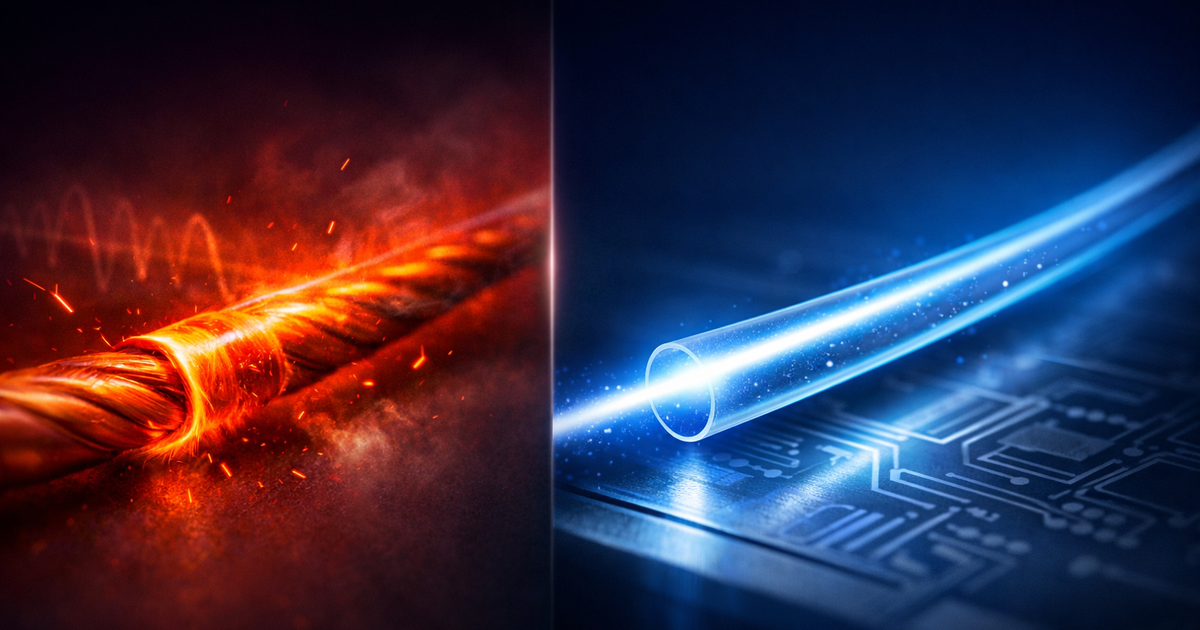
The technology? Silicon photonics — transmitting data as pulses of light through glass pathways etched onto silicon chips, replacing the copper wires that have carried the world's data for the last four decades.
This is the story of why copper is dying, why light is replacing it, who stands to win and lose in the transition, and what it means for the $200+ billion AI infrastructure economy.
The Problem No One Talks About
Here's a number that should bother you: 180 watts per GPU, just for networking.
That's how much power a large AI training cluster burns pushing electrical signals through copper cables to connect its GPUs — at a cost of $6,000 per GPU in optical components alone. Now multiply that by the scale Nvidia envisions: "gigawatt-scale AI factories" housing 100,000+ GPUs, consuming over 40 megawatts of power. At that scale, the power consumed just by the wires connecting the chips exceeds the total power budget of many traditional data centers.
The world has been so focused on the GPU race — Nvidia vs. AMD, training vs. inference, H100 vs. B200 — that almost no one outside the industry has noticed the infrastructure crisis building beneath it. The chips keep getting faster, the models keep getting bigger, but the wires connecting everything together are running into the laws of physics.
Copper is hitting a wall. And the wall is not gradual — it's a cliff.
Why copper worked for 40 years — and why it's failing now
Copper interconnects are governed by a set of electromagnetic constraints that get exponentially worse at higher speeds. The core issue is something called the skin effect: as data rates increase, electrical signals stop traveling through the full cross-section of a copper wire and instead concentrate at the surface. At 56 GHz — the frequency needed for the 1.6 Tbps switch generation — copper traces exhibit approximately 14 dB/m of insertion loss. The signal degrades so fast that receivers can barely distinguish it from noise.
The practical consequence is devastating: at 1.6 Tbps, copper cables can only reach 3 to 5 meters before the signal breaks down. At 3.2 Tbps, even less. But AI data center networks need to span 10 to 300+ meters between racks, and 300 to 800 meters between spine and leaf switches. You can't redesign physics. You can't make copper shorter when the building is 300 meters long.
This isn't a problem you solve with better engineering. It's confirmed across SemiEngineering, TrendForce, and Electronic Design: the industry consensus places the "interconnect wall" at the 1.6T generation for inter-rack connections. Copper will remain viable for ultra-short connections within racks through about 2028, but for the backbone of AI networking, the transition to optics is now a question of deployment speed, not direction.
And there's a cruel irony in the power math. To compensate for signal degradation, copper systems use digital signal processors (DSPs) that consume enormous power:
| Speed | Copper/Pluggable Power | Optical (CPO) Power | Savings |
|---|---|---|---|
| 800G | 14-30W | 5.5-9W | 60-70% |
| 1.6T | 25-30W (DSP) | ~9W | 64-70% |
| 3.2T | 50-60W+ (projected) | 16-20W | 60-67% |
Sources: Link-PP, Hytoptodevice, APNIC
The faster you push copper, the more power you waste fighting physics. In a world where AI data centers are already competing with small cities for electricity, that's not sustainable.
Enter the Light
The replacement is elegant in principle: instead of pushing electrons through copper, you push photons — particles of light — through glass waveguides etched onto silicon chips. Light doesn't suffer from skin effect, doesn't generate electromagnetic interference, and doesn't create crosstalk between adjacent channels. Multiple data streams can share a single strand of glass fiber using different wavelengths of light, a technique called Wavelength Division Multiplexing. Copper fundamentally cannot match this bandwidth density.
This is silicon photonics — and it uses the same semiconductor fabrication processes that make your phone's processor to create optical components: waveguides, modulators that encode data onto light, and photodetectors that read it back. The one thing silicon can't do efficiently is generate the light itself. For that, the industry uses external lasers made from a material called Indium Phosphide (InP) — which is why Nvidia just wrote $4 billion in checks to the two companies that make them.
The leap: Co-Packaged Optics
The most transformative version of this technology is called Co-Packaged Optics (CPO). Today, optical transceivers are separate modules — imagine small plug-in cartridges — that sit at the edge of a network switch. Electrical signals travel from the switch chip across 15-30 centimeters of circuit board to reach these modules, and at 200+ Gbps per lane, that short electrical journey becomes the primary source of signal degradation and wasted power.
CPO eliminates that journey entirely. The optical engines — tiny photonic circuits — are bonded directly onto the switch chip's package using advanced TSMC manufacturing. Data goes from electrical to optical right at the chip, with no lossy copper trace in between. External lasers in hot-swappable front-panel modules feed light to the optical engines via fiber, solving the thermal problem (lasers don't like the 85°C+ heat next to a switch chip — operating at that temperature cuts laser lifespan by roughly 10×).
It's the difference between piping water across a building through narrow, leaky tubes versus connecting the pipe directly to the source. The physics advantage is real, and the products are no longer hypothetical.
What's shipping — and what's coming
Broadcom has been quietly building CPO products since 2021. Its TH6-Davisson, sampling since October 2025, pushes 102.4 Tbps at just 3.5 watts per 800G port — over 70% less power than pluggable alternatives. It supports clusters of 100,000+ GPUs. IEEE Spectrum noted that Broadcom "may be a bit ahead of Nvidia" in CPO deployment — a rare case where the company known for quiet execution is actually the pioneer.
Nvidia's Quantum-X InfiniBand started shipping in H2 2025, with 115.2 Tbps. Its next-generation Spectrum-X SN6800, expected H2 2026, targets a staggering 409.6 Tbps. And at OFC 2026, Coherent demonstrated a 6.4 Tbps CPO link — the most advanced public CPO demonstration to date, confirming the technology road extends well beyond current products.
But here's the number that tells the real story: CPO penetration today is 0.5%. Practically zero. TrendForce projects 35% by 2030. The technology works. The products exist. The adoption curve hasn't even started.
The $3 Billion Market That's Becoming a $30 Billion Market
Six independent research firms have sized this market. Their baselines converge on approximately $3.1 billion for silicon photonics in 2025. Their projections diverge — but all point dramatically upward:
| Source | 2025 Baseline | Projection | CAGR |
|---|---|---|---|
| Mordor Intelligence | $3.11B | $10.36B (2030) | 27.2% |
| Precedence Research | $2.86B | $28.75B (2034) | 29.3% |
| Yole Group | — | $8.1B CPO components (2030) | 137% |
| IDTechEx | — | $20B+ CPO systems (2036) | 37% |
| LightCounting | $5B (AI optics, 2024) | >$10B (2026) | — |
| DataMIntelligence | $9.94B (total optical) | $31.04B (2033) | 15.3% |
There's an apparent contradiction in these numbers — Yole says 137% CAGR while IDTechEx says 37% — but it's not a disagreement. They're measuring different layers of the same supply chain. Yole's $8.1 billion counts the photonic chips sold into CPO integration — the TAM for companies like Coherent, Lumentum, and AAOI. IDTechEx's $20B+ counts the complete systems — CPO-enabled switches including the ASIC, packaging, and integration. The 3-6× multiplier between them is exactly what you'd expect from semiconductor component to finished system. For investors, the distinction is critical: which layer of the value chain are you betting on?
CPO specifically — the most advanced form — sits at just $46 million in 2024. Essentially pre-commercial. Going to $5-8 billion by 2030. That's the steepest growth curve in the semiconductor supply chain.
What's driving this
Four forces are compounding:
First, AI clusters are getting physically enormous. Nvidia envisions gigawatt-scale training clusters growing from 100,000 GPUs toward millions. GPU revenue alone is projected from $100B (2024) to $215B by 2030 (Yole). Every GPU needs to be connected. Every connection needs bandwidth. Every bandwidth jump makes copper less viable.
Second, networking is eating a bigger share of the bill. Data center networking costs are climbing from 5-10% of capex today to an expected 15-20% by 2030. Optical interconnects grow disproportionately within that expanding pie.
Third, the upgrade cycle is relentless. 800G switches are being replaced by 1.6T, then 3.2T — each generation doubles bandwidth and requires entirely new transceiver infrastructure. It's a recurring revenue cycle measured in hundreds of millions of ports.
Fourth — and this is the one most people miss — GPU-to-GPU connectivity is a brand new market. LightCounting explicitly notes that scale-up connections (GPU-to-GPU across racks, at 900 GB/s per GPU) represent entirely incremental TAM for optics. This market did not previously exist. It was created by AI training, and it can only be served by photonics.
The Players: A Story of Bets, Moats, and Supply Chains
Nvidia: Running the HBM playbook again
If you've followed Nvidia's rise, the $4 billion laser investment looks familiar. When High Bandwidth Memory (HBM) was the bottleneck for AI training, Nvidia invested in supply relationships with SK Hynix and Samsung — not to own the technology, but to guarantee it couldn't be bottlenecked. NextPlatform's analysis makes this explicit: the laser investments mirror the HBM strategy.
Nvidia's CPO product lineup — Quantum-X InfiniBand (shipping), Spectrum-X Ethernet (H2 2026) — needs a reliable supply of InP lasers. There are essentially two companies in the world that can make them at the required quality and scale. Nvidia just pre-funded both. The message to the rest of the industry: we will not be supply-constrained.
There's a longer game, too. Both Lumentum and Coherent sell optical circuit switching (OCS) systems — technology that eliminates electrical packet switches entirely for semi-static AI cluster topologies. NextPlatform suggests Nvidia may adopt OCS spines in its Rubin Ultra-era systems, potentially cutting total network power by 65%. The $4 billion buys more than lasers. It buys optionality on the next architecture shift after CPO.
Broadcom: The quiet pioneer
While Nvidia grabbed the headlines, Broadcom has been shipping CPO products since 2021. Four generations. TH6-Davisson is its third-generation production design, and the power numbers — 3.5W per 800G port — are the best in the industry. The gap between Broadcom's 3.5W and Nvidia's ~9W reflects the difference between a third-generation product and a first-generation one.
Broadcom doesn't hold press conferences about this. It doesn't need to. When every hyperscaler needs CPO switches, Broadcom's head start in manufacturing yield, software maturity, and customer integration becomes a moat that's very hard to cross.
Marvell: Betting the company on Celestial AI
Marvell's Celestial AI acquisition is the most aggressive bet in this space. Celestial's "Photonic Fabric" delivers 16 Tbps in a single chiplet — 10× the current state of the art. Amazon's Trainium 4 is the anchor customer. The revenue targets are specific: $500M ARR by January 2028, $1B by January 2029.
The earn-out structure tells you everything about confidence vs. caution: Marvell put $3.25B down because it believes, but only pays the remaining $2.25B if Celestial AI actually delivers revenue. It's a bet, but a hedged one.
Intel: The player everyone underestimates
Here's a surprise: Intel holds 21.5% of the silicon photonics market and has shipped 8 million+ photonic integrated circuits. And it has one differentiator no one else can match: on-chip integrated lasers. Every other CPO approach requires external Indium Phosphide lasers coupled to the silicon chip. Intel demonstrated the first fully integrated Optical Compute Interconnect chiplet co-packaged with a CPU — no external laser needed.
Why does this matter? Because laser reliability is CPO's #1 technical risk. Operating at 85°C instead of 25°C cuts laser lifespan by roughly 10×. The entire ELSFP external laser architecture exists to work around this thermal problem. If Intel's integrated approach proves reliable at scale, it eliminates the most complex part of the CPO supply chain. In a world where everyone else depends on Lumentum and Coherent for lasers, Intel could be the one company that doesn't.
TSMC: The invisible monopoly
Every conversation about silicon photonics eventually leads to one factory. TSMC's COUPE process (Compact Universal Photonic Engine) is the manufacturing technology that bonds optical engines to switch chips using copper-to-copper hybrid bonding at sub-10 micrometer pitch. Both Nvidia and Broadcom depend on it. SemiAnalysis identifies TSMC as "the only foundry that has successfully demonstrated die-to-wafer hybrid bonding capabilities at reasonable scale."
The lock-in is structural: TSMC's COUPE process doesn't package photonic wafers from other foundries. If you use COUPE, your photonic chips must be manufactured at TSMC. No equivalent alternative exists at production yield.
Early yields are 60-65% — meaning 35-40% of $1,000+ optical engines go to scrap. This must improve toward 85%+ for volume economics. But until it does, TSMC controls the bottleneck.
Tower Semiconductor (TSEM) is the primary alternative — already manufacturing 1.6T modules for Nvidia, partnering with Oriole for nanosecond optical circuit switching, and fabricating photonics for Xanadu's quantum computing. It's the hedge against TSMC dependency — and in a world of geopolitical risk, that hedge has value.
The laser duopoly: Coherent and Lumentum
These two companies sit at the most interesting intersection in the entire supply chain: supply-constrained, highest margins, and now pre-funded by Nvidia.
Lumentum is already inflecting. Record Q2 FY2026 revenue of $665.5 million — up 65% year over year. Q3 guided at $805 million, up 85% YoY. Its CW-DFB lasers power Nvidia's Quantum-X (8 lasers per connector). Its R300 MEMS optical circuit switch is deployed in Google's TPU "Palomar" infrastructure, with an OCS backlog exceeding $400 million.
Coherent demonstrated 6.4 Tbps CPO at OFC 2026 and is vertically integrated across lasers, photonic chips, transceivers, and modules. CEO Jim Anderson said it plainly on the Q2 FY2026 earnings call: the scale-up CPO opportunity "will dwarf the opportunity in scale-out... orders of magnitude larger." Initial CPO revenue begins H2 2026, with "more significant revenue contribution next calendar year and beyond."
Both benefit from a structural advantage: no matter which CPO switch platform wins — Broadcom or Nvidia — both platforms need their lasers. They're the arms dealers in this war.
The startup wave
Ayar Labs raised $500 million in March 2026 at a $3.75 billion valuation. Its TeraPHY chiplet pushes 8 Tbps in a standard UCIe form factor with under 25 nanoseconds of latency. Investors include AMD, Nvidia, Sequoia, ARK Invest, and the Qatar Investment Authority. Volume production targeted for 2028.
AAOI (Applied Optoelectronics) is smaller but vertically integrated in InP lasers and transceivers. Its stock surged 22.4% the day Nvidia announced its laser investments. It issued $1B+ 2026 revenue guidance — the first time crossing $1 billion — and secured its fourth hyperscaler volume order.
Where the Money Actually Goes
Not all layers of this supply chain are created equal. The margin hierarchy tells you where the real value accumulates — and where disruption is coming:
LASER SOURCES (InP) ████████████████████ ~50-65% margins ★★★★★ moat
TSMC COUPE FOUNDRY ██████████████████ ~55-65% margins ★★★★★ moat
OPTICAL ENGINES (PIC) ████████████████ ~60% margins ★★★★☆ moat
CPO SWITCH ASICs ████████████████ ~55-65% margins ★★★★☆ moat
PLUGGABLE MODULE ASSEMBLY ████████ ~15-25% margins ★★☆☆☆ moat
Source: SemiAnalysis
Read that from top to bottom and a story emerges.
At the top: laser sources command the highest margins because Indium Phosphide manufacturing is brutally difficult, supply is constrained, and demand is pre-locked by Nvidia's purchase commitments. These companies earn recurring revenue as ELSFP laser modules need replacement across a 5-7 year installed base lifecycle.
In the middle: TSMC's COUPE foundry process has no alternative at production scale. Optical engine designers (Coherent, Intel, Ayar Labs) have high engineering barriers to entry. Switch ASIC makers (Broadcom, Nvidia) capture the highest absolute revenue per unit.
At the bottom: pluggable module assembly — the 15-25% margin business that companies like Innolight and legacy assemblers rely on — faces existential disruption. As CPO integrates optics directly onto the switch chip, the pluggable module becomes unnecessary. This layer doesn't get disrupted gradually. It gets designed out of the architecture entirely.
Revenue inflection: who's making money when
This is the timeline investors care about most — sourced from February 2026 earnings calls:
| Company | Current State | CPO Revenue Inflection | Source |
|---|---|---|---|
| Lumentum | Record $665.5M (+65% YoY) | Now — already inflecting | Q2 FY2026 earnings |
| AAOI | $1B+ 2026 guidance | Now — Q1 2026 | FinancialContent |
| Coherent | CPO design win; 6.4T demo | H2 2026 initial; 2027 meaningful | Q2 FY2026 earnings |
| Broadcom | TH6-Davisson sampling | H2 2026 initial; H1 2027 volume | Product timeline |
| Marvell | Integrating Celestial AI | Mid-2027 ($500M ARR by Jan 2028) | Press release |
| Ayar Labs | $500M raised; TSMC manufacturing | 2028 volume production | NextPlatform |
The pattern is clear: laser companies are making money now. Switch and chiplet companies are a 2027-2029 story. The supply chain lights up from the bottom (photon source) to the top (system integration), and investors positioned at the wrong layer for their time horizon will either be too early or too late.
The Counter-Arguments: What Could Go Wrong
Every good investment thesis needs to survive its best counter-arguments. This one faces five real ones.
1. "LPO might be good enough"
Linear Pluggable Optics (LPO) is the strongest near-term competitive threat. It strips out the power-hungry DSP from traditional pluggable modules, delivering roughly 50% power savings — not as good as CPO's 60-70%, but with a crucial advantage: the modules are field-replaceable. A technician can swap one in 2 minutes. A failed CPO engine means replacing the entire switch.
Arista's Andy Bechtolsheim — one of the most respected networking architects alive — advocates LPO as "good enough" through the current 200G/lane generation. SemiAnalysis calculates CPO saves only 3-7% of total cluster TCO in scale-out networking — not enough to override LPO's serviceability advantages.
But here's why this is a timing risk, not a destination risk. LPO works for scale-out (switch-to-switch) where bandwidth per port is manageable. It does not work for scale-up (GPU-to-GPU) where 900 GB/s per GPU demands bandwidth density that only co-packaged solutions can deliver. By 2028, LPO won't be technically viable for next-generation training clusters. LightCounting's independent forecast: LPO + CPO combined will grow from 30% market share in 2025 to 60% by 2030, but 40% remains deliberately pluggable. The market is big enough for both — but CPO gets the higher-value segment.
2. "Manufacturing yields aren't ready"
TSMC COUPE runs at 60-65% yield. That means for every 3 optical engines produced, roughly 1 goes to scrap — and these engines cost $1,000+ each. SemiAnalysis warns: "The supply chain won't be ready to ship tens of millions of CPO endpoints to support GPU demand" before 2027-2028.
This is real, but it's the kind of problem the semiconductor industry has solved repeatedly. Every new packaging technology starts with low yields. TSMC's track record on yield improvement is the strongest in the industry. The question is timing, not feasibility. InP laser capacity expansion takes 18-36 months — which is exactly why Nvidia pre-funded it now.
3. "Hyperscalers might build their own"
Amazon's Trainium 4 uses Marvell/Celestial AI's Photonic Fabric. Google co-designed its "Palomar" OCS infrastructure with Lumentum. When hyperscalers get deeply involved in silicon photonics design, the fear is that they'll eventually bring it in-house — the way Amazon built Graviton to reduce its dependence on Intel.
The bull case response is structural: even if hyperscalers design their own chiplets, manufacturing stays at TSMC, and lasers stay at Lumentum and Coherent. Specification capture affects the architecture layer but doesn't threaten the photonic component supply chain. The analogy: Apple designs its own chips but TSMC still manufactures them. The foundry and laser layers are where the moats are.
4. "What if AI capex slows down?"
The DeepSeek scenario: algorithmic efficiency improves so dramatically that the urgency to scale physical cluster size diminishes. Nvidia's own NVLink576 roadmap includes copper as the near-term scale-up option — Nvidia historically defers optical integration "as long as possible."
This is the genuine demand risk. But the mitigant is the inference scaling thesis: even if training growth slows, the deployment of AI into millions of concurrent applications requires high-density, power-efficient networking that favors CPO. Training built the demand case; inference sustains it.
A 6-12 month hyperscaler capex deferral could significantly impact 2027-2028 CPO revenue ramps. But Nvidia's multi-year purchase commitment structure provides demand visibility independent of individual hyperscaler order timing.
5. "Reliability at million-link scale is unproven"
Google's Director of Platform Optics said it best: "A link failure rate of 0.004% per day sounds pretty good, but for 1M links that's 40 link failures a day." Each failure can take 64-512 ports offline.
Meta's validation showed zero failures across 4 million port-device-hours — but that's only 15 switches tested for 11 months. Until CPO accumulates 1 billion+ port-device-hours in production, enterprise customers will not deploy at scale. Standards remain fragmented — three new consortia, no ratified IEEE 802.3 CPO standard until late 2027.
This is why the adoption timeline shows 35% penetration by 2030, not 90%. The technology works. Proving it works at scale takes time.
The Bigger Picture
Step back from the technical details and the supply chain maps, and a larger story comes into focus.
The AI revolution has a physical layer. It's not just about algorithms and models and training data — it's about the actual, physical infrastructure that moves information between chips. For 40 years, that infrastructure was copper wire. The physics of copper were good enough for every speed generation humanity threw at it.
They're not good enough anymore.
The transition from copper to light isn't just a product upgrade. It's an infrastructure layer replacement — comparable to the shift from copper telephone lines to fiber optics in telecommunications, or from hard drives to SSDs in storage. These transitions share a pattern: they start slowly, face legitimate "good enough" counter-arguments from incumbent technology, encounter manufacturing and yield challenges, and then accelerate non-linearly once the cost curves cross. The total optical components market is already $17 billion (OMDIA/OFC), with datacom exceeding 60%.
The $9.5 billion committed in one week of March 2026 is the inflection signal. It's not venture capital speculating on a possibility. It's the companies building AI's physical infrastructure saying: we know what comes next, and we're securing supply now.
For the global economy, this transition creates a new critical supply chain — one that runs through TSMC in Taiwan (a geopolitical concentration risk that should concern everyone), through two InP laser manufacturers in the United States, through a handful of optical engine designers, and ultimately into the data centers that power every AI application on the planet.
The companies that control the chokepoints — the lasers, the foundry process, the switch ASICs — will capture the value. The companies that sit in commoditized layers — pluggable assembly, generic transceivers — will be disrupted. And the timeline, while debatable in its exact years, is not debatable in its direction.
Light is replacing copper. The only question is how fast.
The Adoption Roadmap
| Period | What Happens | Evidence |
|---|---|---|
| 2021-2022 | Broadcom ships CPO Gen 1-2 quietly | TH4-Humboldt, TH5-Bailly |
| H2 2025 | First production CPO switches from Nvidia and Broadcom | Quantum-X shipping; TH6-Davisson sampling |
| 2026 | Commercial CPO available; 0.5% penetration | Nvidia Spectrum-X H2 2026; TrendForce |
| 2027 | IEEE standards ratified; CPO volume ramp begins | Marvell $500M revenue target |
| 2028 | Production scale; Ayar Labs volume | ~15-20% penetration |
| 2028-2030 | Large-scale deployment across hyperscalers | ~35% CPO penetration (Yole, TrendForce, IDTechEx) |
| Mid-2030s | "All interconnects optical, all CPO" | Needham & Company forecast |
Key Takeaways
1. The copper wall is real and imminent. At 1.6T+ speeds, copper cannot physically reach the distances AI data center networks require. This is a physics cliff, not a gradual decline.
2. $9.5 billion in one week is the conviction signal. Nvidia's purchase commitments and Marvell's earn-out structure tell you this isn't speculation — it's supply chain preparation for a known transition.
3. CPO is at 0.5% penetration today. The growth curve from $46M (2024) to $5-8B (2030) at the component level is the steepest in the semiconductor supply chain.
4. Value concentrates at supply-constrained chokepoints. InP lasers (50-65% margins, near-monopoly) and TSMC COUPE (no alternative) are the highest-conviction positions. They win regardless of which CPO switch platform dominates.
5. Laser companies are inflecting now; switch companies are 2027-2029 stories. Lumentum (+65% YoY) and AAOI ($1B+ guidance) are already in their ramp. Coherent starts H2 2026. Marvell and Ayar Labs are 2027-2028 revenue stories.
6. Scale-up networking is the new market. GPU-to-GPU connectivity at 900 GB/s didn't exist before AI training created it. This is incremental TAM that only photonics can serve — and it's where CPO wins decisively over LPO.
7. The biggest risks are timing, not direction. LPO may delay CPO by 12-18 months. Yields must improve. Standards must be ratified. Reliability must be proven at million-link scale. But the physics are settled.
8. Valuations already price in significant success. Lumentum at ~24× P/S and Coherent at similar multiples require sustained growth. AAOI offers a less pre-priced entry with higher execution risk. Know which supply chain layer you're betting on — and whether the market has already priced it in.
Sources and References
Primary Investment Events
- CNBC — Nvidia $4B in Coherent and Lumentum
- HPCwire — Nvidia $4B Silicon Photonics Investment
- NextPlatform — Nvidia Silicon Photonics & Optical Switching Analysis
- Marvell — Celestial AI Acquisition Press Release
- CNBC — Marvell Celestial AI $5.5B Deal
Earnings Calls and Company Guidance
Market Research
- Yole Group — Co-Packaged Optics 2025
- IDTechEx — CPO 2026-2036
- LightCounting — AI Cluster Optics Jan 2025
- LightCounting — Scale-Up as New Market Jul 2025
- Mordor Intelligence — Silicon Photonics Market
- Precedence Research — Silicon Photonics Market
- DataMIntelligence — Optical Interconnect AI Data Centers
- TrendForce — CPO Penetration March 2026
- Cignal AI — 800GbE Optics Growth 2025
- Yole Group — Data Center Semiconductor Trends 2025
- Yole Group — Silicon Photonics & CPO
Technical Analysis
- SemiAnalysis — CPO Book
- APNIC — Co-Packaged Optics Deep Dive
- SemiEngineering — 1.6 Tbps Interoperability
- SemiEngineering — Photonics Speeds Up Data Center AI
- Siemens — Five CPO Trends 2026
- Vik's Newsletter — Why CPO Uses External Lasers
- Electronic Design — Copper, Optical, and Plastic Interconnects
Company Products and Announcements
- Broadcom TH6-Davisson Press Release
- Nvidia Silicon Photonics Products
- Intel Silicon Photonics Products
- Intel OCI Chiplet Demo
- Cisco Silicon One G300
- Ayar Labs $500M Series E
- Tower Semiconductor / Nvidia Partnership
- Tower Semiconductor / Oriole OCS
- OFC 2026 Coverage — Converge Digest
- Optics.org — Nvidia GTC 2025
Industry Analysis
This report was produced by the Eightgen Research Division on March 18, 2026. All claims are cited with primary sources. This is not financial advice.